Sunday, December 27, 2015

The Fed and Rate Changes - What does it all mean?


The Federal Reserve Board (the Fed) controls the Fed Funds Rate and the Discount Rate. These are overnight loans from bank to bank or from the Fed to member banks. The Fed adjusts the rate to influence the economy. For example, if things are going well, a rate increase may slow inflation. If the economy is struggling, a rate drop could be the boost it needs.

Two important things to remember:
- The Fed can influence, but does not directly set, consumer rates.
- The Fed's rates are short term and often do not impact longer term rates, such as mortgage loans.

Why all the fuss?
Increases in the Fed Funds rate can cause banks to raise their “prime” rates, which are often used to calculate costs of revolving credit or home equity lines of credit (HELOCs).

What about mortgages?
Mortgage loans are a different animal, so to speak. The "agencies" (Fannie Mae and Freddie Mac) pool them together and sell them as mortgage bonds. The amount investors pay for these bonds directly influences mortgage rates.

Bottom Line:
When the Fed moves, it generally provides lots of warning, and markets have already had a chance to react. Markets are constantly responding to other factors as well, from the stock market to global events to consumer spending. In the end, no one can say for certain what the reaction to Fed moves will be.

Wednesday, December 02, 2015

St. Louis Will Be the Nation's Second Hottest Real Estate Market in 2016

St. Louis Will Be the Nation's Second Hottest Real Estate Market in 2016


St. Louis Will Be the Nation's Second Hottest Real Estate Market in 2016

Posted By  on Wed, Dec 2, 2015 at 6:00 am

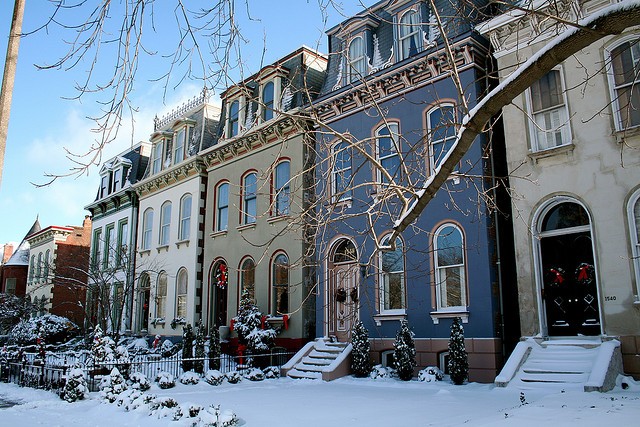
Realtor.com predicts the median home price in St. Louis rising 10 percent in 2016. - PHOTO COURTESY OF FLICKR/DUSTIN PHILLIPS
  • Photo courtesy of Flickr/Dustin Phillips
  • Realtor.com predicts the median home price in St. Louis rising 10 percent in 2016.

Brooklyn? It's a joke. San Francisco? So last year.


The hottest real estate markets in 2016 are going to be Providence, St. Louis, and San Diego — in that order.


That's according to Realtor.com, which places the St. Louis metro area at No. 2, ahead of not just San Diego but top-10 markets Sacramento, Atlanta, New Orleans and Charlotte. It shows St. Louis real estate inventory moving faster than the U.S. overall, online listings getting more views than other markets, and demand increasing as the local economy continues to improve.

"Next year looks to be the best year St. Louis has had in quite some time," says Jonathan Smoke, chief economist for Realtor.com. "We've been seeing strong demand in St. Louis, and if anything, it's starting to heat up even more."

Realtor.com predicts that single-family home sales in the St. Louis area will increase by 8.6 percent compared to 2015 — with median home sale prices up 10 percent.

The website's analysis looks at a variety of factors, including mortgage rates, household income, and new housing starts. "There is no national real estate market," he observes. "There are 1,000 local housing markets. So we're looking at every individual market in the country."

St. Louis also finished third in the website's analysis of a market's success with "young Gen-X homebuyers," finishing behind only Atlanta and Denver, and just ahead of Charlotte, in terms of its 2016 prospects with those between the ages of 35 and 44.

Indeed, Smoke notes that, of all mortgages made in the St. Louis area this year, 42 percent are for buyers ages 25 to 34. That's something you're not seeing in California or New York.

"It's an extremely attractive market from the affordability standpoint," he says. "It's a great opportunity for anyone looking to start a family, or especially Gen Xers, who were most negatively influenced by the last housing downturn." They bought their first home at the peak of the market, Smoke notes, and subsequently suffered the largest share of foreclosures.

Now, in St. Louis at least, Gen Xers are showing they're ready to try again. And with the area poised to see job growth and household income rising at a pace faster than the national area, the housing market overall could be hot, hot, hot.

"If you're planning to buy next year, start early," Smoke cautions. "There's more inventory on the market relative to the people who want to buy in January and February compared to May, June and July. That tilts the demand in your favor." And next year in St. Louis, if the study's projections prove right, you just might have to be that crafty. How cool is that?

Wednesday, November 18, 2015

Living Smart: Preparing your home for fall weather

Experts say that unless you enjoy reseeding in spring, you shouldn’t leave leaves on the lawn over winter. So another seasonal question worth asking is whether to take the time and risk the blisters to do the job yourself or hire some help.
Top-rated lawn pros tell our researchers that leaves left to pile up can form a heavy mass that can kill or damage grass and ornamental plants. Matted leaves block sunlight and reduce water evaporation, which can cause fungus, mold and disease. These alone can wipe out a lawn in a year or two.
Experts say that smaller leaves that decompose quickly or blow away — such as those from honey locust, dogwood, ginkgo and birch trees — can often be left on the ground if they don’t get too thick.

There are two main ways to clear leaves: Running a mower over them, sometimes repeatedly, to reduce them to small bits that can be left on the lawn as added nutrients, or raking and gathering them.
Because leaves are a natural material that, in the right setting, biodegrade into a wonderful soil amendment, you may want to avoid bagging them and having them taken to a landfill. At the least, consider paper bags, which decompose more quickly than plastic.
Most landscaping companies offer leaf removal services. A common method the pros use involves mobile vacuuming to remove even the smallest leaf bits from your lawn. Or, they may rake leaves onto a tarp, and haul them away on a trailer.
If you’re thinking of hiring a lawn pro to help with leaf maintenance, you may want to wait until almost all your leaves are down before calling, or you may prefer to have them come out several times. One top-rated lawn pro told our team that most customers request two leaf clearings: one before Thanksgiving and another before Christmas.
Prices range widely. Some companies will charge a flat fee to cover the cost of coming out and using equipment, with an additional hourly charge to cover labor. Top-rated service providers said price ranges start at about $100 and can rise to about $375 for a 10,000-square-foot property.
For recommendations about reliable lawn companies, talk to neighbors and friends and consult a trusted online source. Get several bids and ask for and check references. Make sure the company you hire is appropriately licensed for your location.
When hiring, ask for a free estimate and find out where the company takes the leaves. Some take them to a recycling facility, where they’re composted over winter and sold to landscapers in spring as a soil amendment. Companies may also chop leaves and apply them to your garden or compost pile.
———
ABOUT THE WRITER
Angie Hicks is the founder of Angie’s List, a resource for local consumer reviews on everything from home repair to health care. Follow her on Twitter at @Angie_Hicks.

Wednesday, November 11, 2015

Home Sales Are Up Again

A month-over-month dip in home sales last month caused real estate watchers to ponder—gasp—a potential cooling of the market. But on Thursday the National Association of Realtors® reported that sales are up again.
Existing-home sales—completed sales of single-family homes, townhomes, condominiums, and co-ops—rose 4.7% from August to September, reaching 5.55 million. That’s the 12th consecutive month to see year-over-year growth, and the second-highest peak since February 2007, when sales totaled 5.79 million.
The median existing-home price for all housing types was $221,900 in September, 6.1% more than September 2014. This is the 43rd consecutive month that we’ve had year-over-year gains. Single-family home sales increased 5.3%, with a median price of $223,500, while condo and co-op sales remained unchanged, with a median existing-condo price of $209,200.
All-cash sales rose, too: They represented 24% of transactions in September, up from 22% in August. Short sales stayed on the market for an average of 135 days, but short sales and foreclosures are still down from a year ago—7% now and 10% then.
Why the reversal on sales in general? These are seasonally adjusted numbers, so they don’t reflect the typical fall slowdown. August sales, however, were affected by the stock market dips that shook buyers’ confidence.

Please, Mr. P

   “Sales are impacted by major stock market declines, since at least one in five buyers funds at least a portion of their purchase with stock or retirement funds,” said realtor.com® chief economist Jonathan Smoke. “But barring stock corrections that reflect real economic downturns—which we are not experiencing—homes sales typically return to the prior trend after stock values stabilize.”
But not all numbers were up: Inventory decreased 2.6% and is 3.1% lower than a year go. There’s a 4.8-month supply of unsold housing—in August, it was 5.1 months.
Maybe it’s counterintuitive—how can there be more sales when there’s less inventory?
It’s all that pent-up demand. Unfortunately for first-time buyers, all that competition has driven house prices up; you’re more likely to buy a home if you already have one.
“First-time buyers fell to 29% of sales in September after climbing to their highest share of the year in August (32%),” according to the NAR. “A year ago, first-time buyers represented 29% of all buyers.”
That’s the biggest surprise, Smoke said, but “despite that decline, we estimate from the monthly sales data this year that first-time buyers have been responsible for 45% of the growth in sales over last year.”
Whether the rise in existing-home sales continues depends on one thing: jobs. The 6% rise in prices is just about double the pace of wages. We need more, and better-paying, employment to keep sales up. That’s complicated by the fact that most future job growth is rooted in the relatively low-paying service sector. Sales may be up, but we’ll need inventory to rise with them.

Regional breakdown

Northeast: September existing-home sales rose 8.6% to an annual rate of 760,000, 11.8% above a year ago. The Northeastern median price was $256,500, 4% above September 2014.
Midwest: September existing-home sales rose 2.3% to an annual rate of 1.31 million, 12% above a year ago. The Midwestern median price was $174,400, 5.4% above September 2014.
South: September existing-home sales rose 3.8% to an annual rate of 2.21 million, 5.7% above a year ago. The Southern median price was $191,500, 6.2% above September 2014.
West: September existing-home sales rose 6.7% to an annual rate of 1.27 million, 9.5% above a year ago. The Western median price was $318,100, 8% above September 2014.

By
Lisa Davis  Realtor.com

Monday, November 02, 2015

This week in real estate


Solid domestic consumer demand helped 3rd quarter GDP estimates to increase 1.5%. Strong economic news can lead to higher rates.

As expected, the Fed did not raise policy rates at this month's FOMC meeting. However, the statement contained language making a hike in December possible.

The four-week average for jobless claims is the lowest since 1973. A strong labor market helps strengthen the economy and could lead to higher rates.

New home sales fell in September after two straight months of gains. However, the drop is seen as temporary, and demand for housing remains strong.

In fact, the homeownership rate rose between July and September, the first rise after 7 quarterly declines. Buyers under 35 years old had the highest increase.

First time homebuyers are depending less on gift funds for down payments. More young buyers are using personal savings for down payments and closing costs.

Wednesday, October 28, 2015

St. Louis Arch celebrates 50 years


The Gateway Arch in St. Louis is 630 feet tall - 63 stories - and tthe span between the legs is 630 feet wide at the base.

It is made out of concrete and steel.
Browse this timeline of benchmark moments that make up the inspiring story behind the tallest man-made national monument – the Gateway Arch.
1933 | Civic leader Luther Ely Smith conceived the idea for the memorial as a way to help revitalize the riverfront and stimulate the economy.
1934 | The Jefferson National Expansion Memorial Association [JNEMA] was chartered.
1935 | JNEM was created through a Presidential proclamation and became a unit of the National Park Service.
1947 | An architectural competition was held to decide the design of the memorial.
1948 | Architect Eero Saarinen’s design of a stainless steel Arch won the contest.
1958–1961 | Saarinen perfected his design.
1959 | On June 23, 1959, St. Louis celebrated with a groundbreaking for the memorial.
1961 | Excavations for the foundations began.
1962 | The Bi-State Development Agency was asked to finance the $2 million tram system that would take visitors to and from the top of the Arch. They did so by selling revenue bonds, which allowed trams to open in 1967.
1963 | Construction began on February 12, 1963.
1963 | Work was delayed due to a strike by hoisting and operating engineers. Later, construction on the south leg was delayed because of problems achieving the proper tension in the interior sections.
1965 | The final section was placed and the Arch was completed on October 28, 1965.
1966 | The Building and Construction Trades Council unanimously voted to stop work on the visitor center over issues of hiring contractors not affiliated with the American Federation of Labor-Congress of Industrial Organizations (AFL-CIO). This controversy was initiated when an African-American plumbing company was hired in an effort to meet federal equal opportunity requirements. Later, a temporary injunction was filed that required union workers to return to work.
1967 | The Visitor Center opened to the public and visitors took their first ride on the north trams.
1976 | The Museum of Westward Expansion opened to the public.
1981 | Landscaping was completed.
1991 | The underground visitor center was augmented with a 70mm giant-screen theatre, as well as exhibits throughout the tram load zones.
1998 | The north and south tram load zones were extensively renovated to create additional space for museum displays. The three-story atrium was altered by the infill of the concrete flooring slab, removal of the concrete guard walls and installation of carpeting over the terrazzo flooring.
2001 | Permanent floodlights were installed to light the Arch exterior.
2003 | The Grand Staircase was completed.
2009 | CityArchRiver hosted a design competition for renovations to the Arch grounds.
2015 | St. Louis celebrates the 50th Anniversary of the completion of the Arch.

Monday, October 05, 2015

TRID - how does it affect your closing on your home?


Loan Estimate: 3 Days after application, 7+ Days before Closing
Lists estimated loan costs and terms. Saturdays do NOT count.

*If Required* Revised Loan Estimate: 1+ Days before Closing Disclosure, 4+ Days before Closing
Details any revised loan costs and terms if there is a significant change. Saturdays do NOT count.

Closing Disclosure: 3+ Days before Closing
Confirms final loan costs and terms. Saturdays DO count.

Examples of significant changes that could trigger a Revised Loan Estimate include (but are not limited to) setting the rate lock or making any change to the loan type or loan amount.

These disclosures and their required timing exist for your clients' protection. We assure you we will do what we can to get your clients to the closing table on time. If you have questions about the forms or the timetable, please ask. I am here to help.


David Sharp
MiMutual Mortgage
Loan Officer
NMLS# 280482
(314) 862-0123 x 4360
dsharp@mimutual.com
www.mimutual.info/dsharp